

What 50,000 Handwritten “M”s Are Teaching Us About How Children Learn to Write
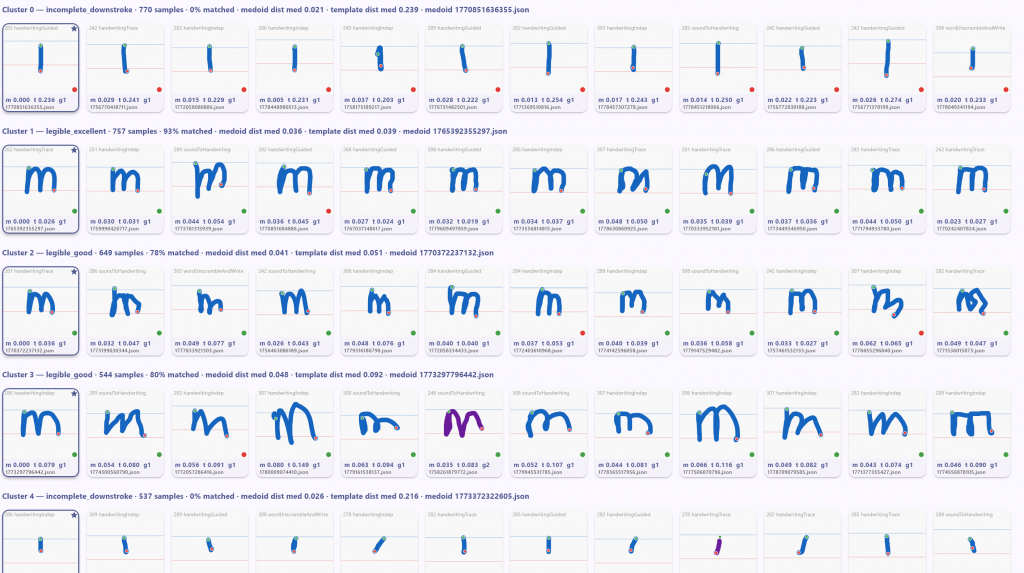
At SonicPhonics, every handwriting attempt tells a story.
Over the past few weeks, we’ve analysed more than 50,000 handwritten letter “m”s written by children using our app. What began as a way to better understand handwriting recognition quickly became something much bigger. It gave us a unique opportunity to learn how children actually develop handwriting skills and how we can build better tools to support them.
Looking Beyond Right and Wrong
Most handwriting technology is designed to answer one question:
“What letter is this?”
That is useful, but it only tells part of the story.
As educators, we are just as interested in another question:
“How well has this letter been formed?”
There is a big difference between recognising that a child has written the letter “m” and understanding whether they are developing good handwriting habits. A child may write a recognisable “m” while still needing support with size, stroke sequence, fluency or letter formation.
That distinction is where real learning happens.
One Statistic That Changed Our Thinking
When we analysed all 50,000 attempts, one result stood out immediately.
37.2% of children stopped writing before completing the letter “m”.
At first glance, it would be easy to assume these children simply did not know how to write the letter.
But the data told a different story.
Children were not stopping randomly. They consistently paused at the same natural movement points throughout the letter. The most common stopping points were:
– 17.8% after the initial downstroke
– 10.9% after completing the first hump
– Smaller groups paused at other natural transitions throughout the letter
These are exactly the points where young children often pause to think about their next movement or where they have been taught to lift their pencil during early handwriting instruction.
This made us ask a completely different question. Instead of asking why children were failing, we started asking what these pauses could teach us about how children learn.
Understanding How Children Write
The more handwriting samples we reviewed, the more patterns began to emerge.
Across the dataset, we found:
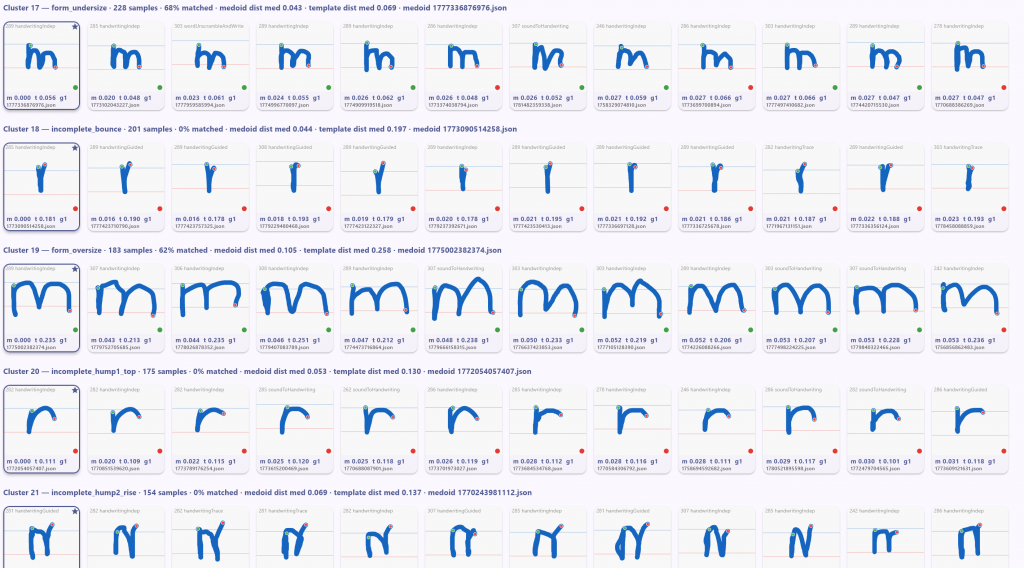
– 42.0% of attempts were legible
7.4% excellent
32.3% good
2.3% messy but readable
– 37.2% were incomplete
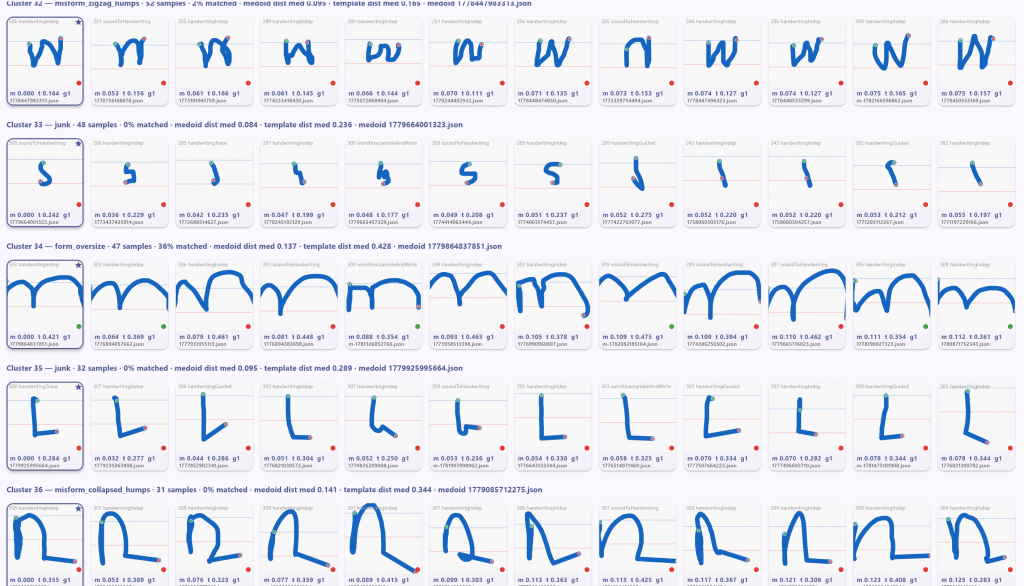
– 9.8% showed size differences, such as oversized or undersized letters
– 6.3% showed letter formation mistakes like turning instead of bouncing, collapsed humps or extra strokes
– 4.6% were too incomplete or unclear to evaluate
Rather than viewing these as mistakes alone, we began to see them as learning patterns. Every category represents an opportunity to improve instruction.
Building Teaching Around Real Behaviour
This research has encouraged us to rethink how handwriting feedback should work.
Imagine a child who pauses halfway through writing the letter “m”.
Today, many handwriting systems immediately mark the attempt as incorrect because the child lifted their pencil.
But what if they knew exactly how to finish the letter?
Instead of ending the attempt immediately, we are exploring ways to allow children to continue writing before giving feedback. That means feedback could become:
“Great job writing your letter. Next time, see if you can write it in one smooth movement.”
Rather than:
“Incorrect.”
This small shift changes the experience from punishment to coaching. Children receive encouragement while still learning the importance of fluent handwriting.
A New Way to Measure Progress
One of the most exciting outcomes of this research is the possibility of measuring handwriting development over time. Instead of only recording whether a child was right or wrong, we can begin tracking progress such as:
– How often do they lift their pencil
– Whether letters become more consistent in size
– How letter formation improves over time
– When multiple strokes naturally become one smooth movement
– For teachers, this creates a much richer picture of learning.
– Instead of simply seeing that a student completed the activity, they can see how handwriting fluency develops throughout the year.
Training AI With Children’s Handwriting
Perhaps the most exciting opportunity from this project is what comes next.
We are using these 50,000 handwritten “m”s to build an AI model trained specifically on children’s handwriting.
This is a unique dataset.
Very few organisations have access to tens of thousands of handwritten letters created by young children in authentic learning situations.
Traditional handwriting recognition systems are designed to identify which character has been written.
Our goal is different.
We want our model to understand handwriting quality, and to make this possible, every one of the 50,000 handwritten “m”s was carefully reviewed and grouped with similar examples.
These groups were then labelled according to handwriting quality, including: Complete, Incomplete, Well-formed, Developing, and Incorrectly formed
These labelled examples become the foundation for teaching the AI what high-quality handwriting looks like, while also recognising the many stages children move through as they learn.
Rather than simply recognising the letter “m”, the model learns to evaluate how well it has been written. That opens the door to more meaningful feedback, better progress tracking and teaching that reflects real handwriting development.
Learning From Every Letter
This project has reinforced something we have always believed.
Children’s mistakes are not just mistakes.
They are information.
Every hesitation, every oversized letter, every extra stroke and every beautifully formed letter helps us understand how children learn. The more we understand those patterns, the better we can support teachers and learners.
Our goal has never been to build technology for its own sake. Our goal is to build technology that helps children become confident writers, gives teachers meaningful insights and continually improves through real classroom learning. Those 50,000 handwritten “m”s are only the beginning.
Ready to experience SonicPhonics?
Everything we’ve shared in this article comes from one simple goal: helping children become confident readers and writers through better teaching, better feedback and continuous improvement. Every handwriting attempt helps us learn. Every insight helps us refine the app. Every update brings us one step closer to giving teachers an even more effective classroom tool.
If you’re an early years teacher looking for structured literacy resources that continue to evolve alongside real classroom learning, we’d love for you to try SonicPhonics.
Why teachers choose SonicPhonics
– Free for teachers with access to our classroom Teacher Tool.
– Designed specifically for New Zealand classrooms, including authentic Kiwi pronunciation.
– Strict handwriting guidance that helps children build correct letter formation from the very beginning.
– Continuously improving handwriting feedback, powered by real learning data from thousands of children’s writing samples.
– Individualised learning, allowing children to work at their own pace while teachers identify who needs extra support.
– Meaningful teacher insights that go beyond scores to show handwriting progress and learning patterns.
– Aligned with structured literacy, helping children develop phonics, reading, spelling and handwriting together.
– Built with teachers, informed by classroom feedback, and continually refined through ongoing research.
At SonicPhonics, we believe technology should support great teaching, not replace it. Every improvement we make is driven by one question:
How can we help teachers spend less time assessing and more time teaching?
We’re only just getting started, and we’d love you to be part of the journey.
Try SonicPhonics today and discover how data-driven insights can help every child become a more confident learner.
How do we work?
Glad you asked!
First, guide learning and track progress via our Teacher tool.
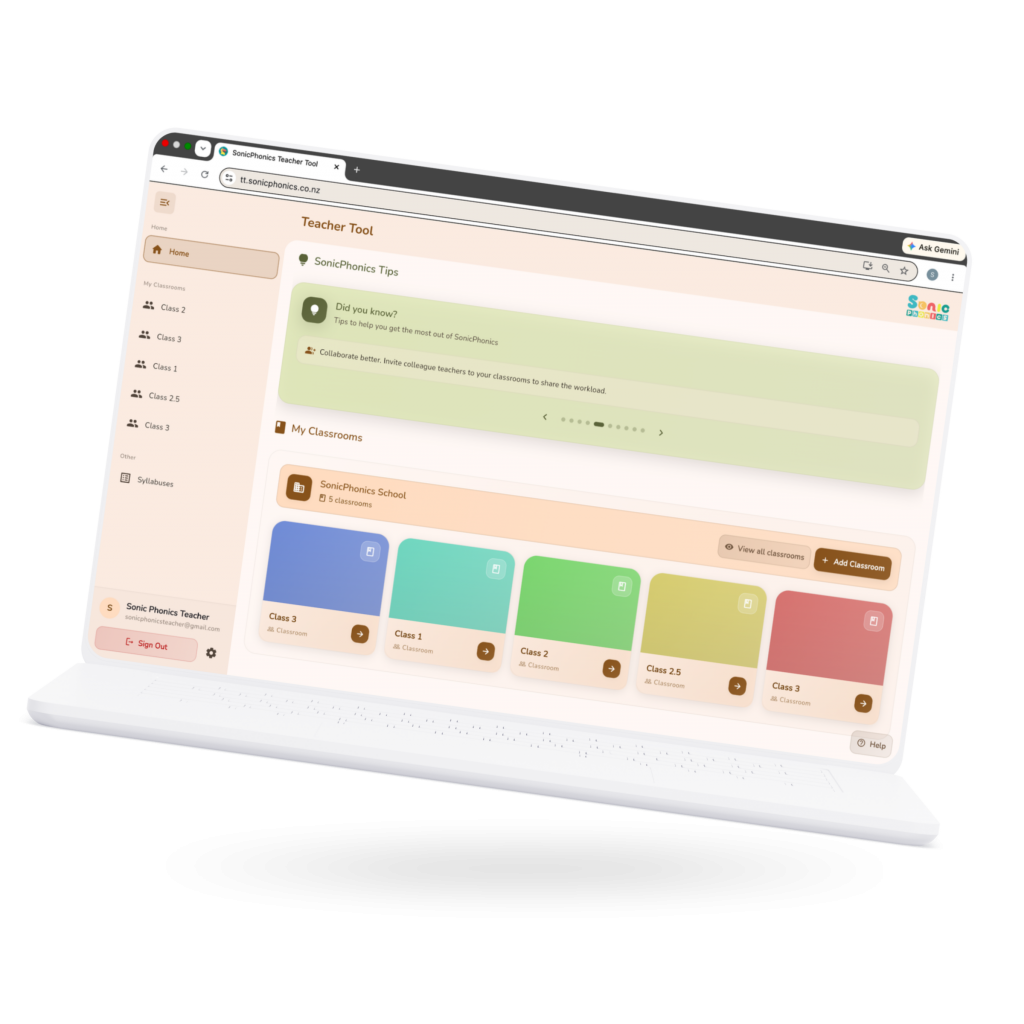
Then, build confident readers through practice, with our SonicPhonics app.